what did johnson require states to do to regain membership in the union?

NPS Epitome
Reconstruction or Restoration?
Following the Union victory in the Civil State of war, the nation faced the uncertainty of what would happen next. Two major questions arose. Were the Confederate states nevertheless office of the Union, or, by seceding, did they need to reapply for statehood with new standards for admission?
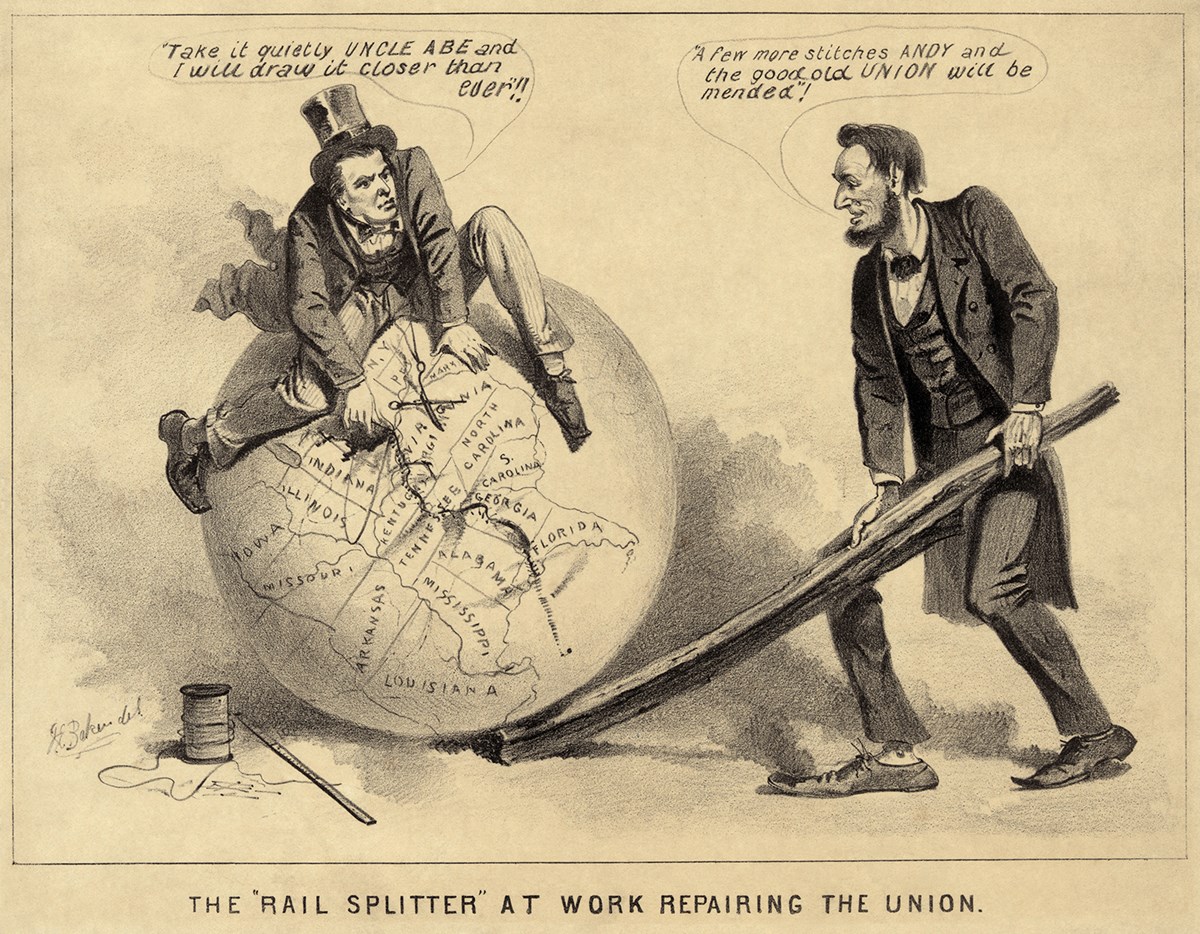
Andrew Johnson's view, as stated higher up, was that the war had been fought to preserve the Union. He formulated a lenient plan, based on Lincoln'due south before 10% plan, to permit the Southern states to begin belongings elections and sending representatives dorsum to Washington.
His amnesty proclamations, nevertheless, emboldened former Confederate leaders to regain their former seats of power in local and national governments, fueling tensions with freedmen in the Southward and Republican lawmakers in the North.

NPS Image
Altogether, several variations of Reconstruction arose:
The Declaration of Immunity and Reconstruction, or Lincoln's X Percent Programme
As Spousal relationship troops took command of areas of the South, Lincoln implemented this war-time mensurate to re-establish country governments. It was put forth in hopes that information technology would give incentive to shorten the war and strengthen his emancipation goals, since information technology promised to protect private property, non including slaves.
At its cadre, the plan stated that when 10% of the 1860 voters from a state had taken an oath of allegiance to the U.Due south. and pledged to abide by emancipation, voters could then elect delegates to draft new state constitutions and establish state governments. About Southerners, excepting high-ranking Confederate army officers and government officials, would be granted a full pardon.
This plan would serve as a platform for whatever mail service-state of war reconstruction would be adult.
The Wade-Davis Agreement, or Congress's Response to the X Per centum Plan
Congress felt that Lincoln's measures would let the South to maintain life as it had before the war. Their measure required a majority in former Confederate states to take an Ironclad Oath, which essentially said that they had never in the past supported the Confederacy. The bill passed both houses of Congress on July 2, 1864, simply Lincoln pocket vetoed it, and it never took effect.
NPS Epitome

NPS Paradigm
Presidential "Restoration," or Andrew Johnson'southward Plan for Reconstruction
Post-obit Abraham Lincoln's death, President Andrew Johnson based his reconstruction programme on Lincoln'due south earlier mensurate. Johnson'south plan also called for loyalty from 10 per centum of the men who had voted in the 1860 ballot. In improver, the plan called for granting amnesty and returning people's property if they pledged to be loyal to the U.s.. The Amalgamated states would exist Under the plan, Confederate leaders would

A.J. (Driver of Engine "President") - "Wait here! Ane of united states has got to back!"
Thaddeus (Driver of Engine "Congress") - "Well it own't me that'southward going to do it! You bet!"
NPS Image
Congressional Reconstruction, or the Military Reconstruction Acts
Passed on March 2nd, 1867, the first Military Reconstruction Act divided the ex-Amalgamated states into five war machine districts and placed them under martial law with Union Generals governing. The human action as well directed that former Southern states seeking to reenter the Union must ratify the 14th Amendment to the Constitution to be considered for readmission. The 14th Amendment granted individuals born in the U.s. their citizenship, including nearly 4 meg freedmen.
The amendment specifically disenfranchised ex-Confederates, barring them from the ballot box. The Constitution states, "Whoever, owing allegiance to the U.s., levies war against them or adheres to their enemies, giving them aid and condolement within the U.s. or elsewhere, is guilty of treason." At the time, their actions were viewed as treasonous. The Confederate States of America's leadership lost their right to vote because they lost their citizenship past committing treason.
The Military Reconstruction Act besides protected the voting rights and concrete safe of African Americans exercising their rights equally citizens of the Usa.
The Outc ome
Andrew Johnson and Congress were unable to agree on a plan for restoring the ravaged country following the Civil State of war. In that location was a marked divergence between Congressional Reconstruction - outlined in the first, 2nd, and third Military Reconstruction Acts - and Andrew Johnson's plan for Presidential Restoration (North Carolina'due south plan shown here).
In the midst of information technology all was the human being aspect.
The Bureau of Refugees, Freedmen, and Abandoned Lands, often referred to as the Freedmen's Agency, was established past the War Section on March third, 1865. The Agency supervised relief and educational activities for refugees and freedmen, including issuance of food, clothing, and medicine. The Bureau also assumed custody of confiscated lands or property in the old Confederate States, edge states, District of Columbia, and Indian Territory.
Backlash occurred in the South in the course of the Black Codes. Passed in 1865 and 1866 in Southern states after the Ceremonious State of war, these Codes severely restricted the new-found freedoms of the formerly enslaved people, and it forced them to work for low or no wages.
Crippling poverty, vast wealth, rampant rumors, fear of insurrection on all levels, bump-off, trials - this was the state that all iii branches of the Federal regime inherited afterwards the war.
The Congressional Plan of Reconstruction was ultimately adopted, and it did not officially stop until 1877, when Matrimony troops were pulled out of the Due south. This withdrawal caused a reversal of many of the tenuous advances made in equality, and many of the issues surrounding Reconstruction are still a function of society today.
Source: https://www.nps.gov/anjo/andrew-johnson-and-reconstruction.htm
0 Response to "what did johnson require states to do to regain membership in the union?"
ارسال یک نظر